AZURE NETWORKING / LAB-002
Application Gateway with two IIS backends
Adapting Bicep to an existing network, selecting a VM size and validating two web servers behind a single entry point.
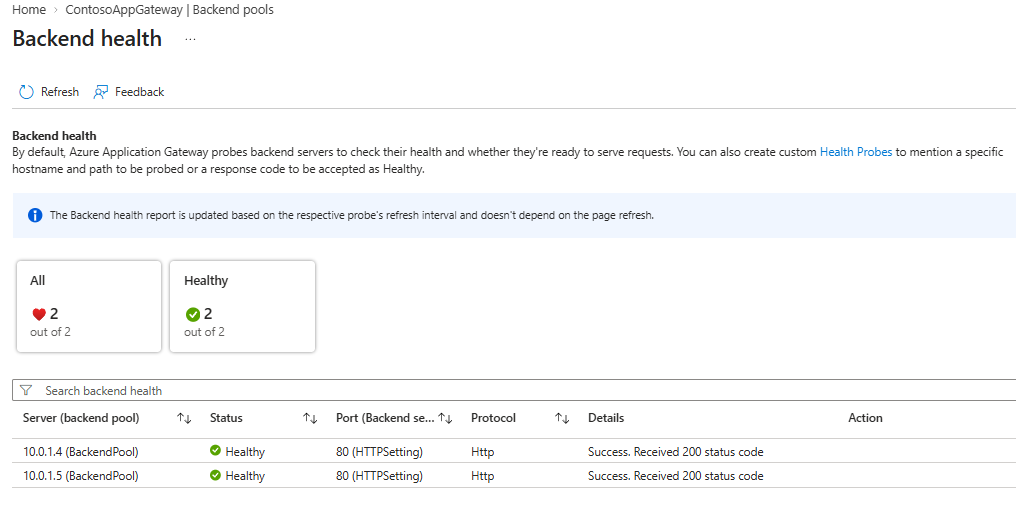
AZ-700 · M528 September 2026Recovered historical evidenceDocumented outcome: Both backends show Healthy with HTTP 200. Subsequent screenshots show responses from BackendVM1 and BackendVM2. No failure test was performed.
01 / Architecture and objective
The M5 lab resumed with ContosoVnet, its subnets and ContosoAppGateway already deployed. The objective was to add two IIS VMs without managing the existing network configuration again.
HTTP client → public frontend → ContosoAppGateway
ContosoVnet
  AGSubnet → Application Gateway → listener / rule → BackendPool
  BackendSubnet
    ├─ BackendVM1 · 10.0.1.4 · IIS :80
    └─ BackendVM2 · 10.0.1.5 · IIS :80
The client used one public Gateway IP. Private VM addresses were registered as backend targets. Diagram addresses belong to the historical lab; they are not current endpoints to test.
02 / Adaptations and decisions
Reference the network with existing
Originals were preserved and main.Juan-existing-network.bicep was created separately. The VNet and BackendSubnet use existing declarations, and NICs reference backendSubnet.id. The corrected file retains two VMs, two NICs and two IIS extensions; it does not declare a new Application Gateway.
Adapt the VM size to available constraints
The corrected parameter file uses Standard_D2s_v7, supported by the template, instead of D2s_v5. History records this choice in response to SKU/quota constraints. It does not establish a universal Free-account quota or current availability of that size.
Validate before deployment
History records compilation, Cloud Shell validation and a What-If with six creates and three ignored resources, without modifications or deletions. An approved incremental deployment was then recorded as successful. These are historical chat results, not new runs during this recovery.
Register backend targets explicitly
After VM creation, BackendPool still had no targets. Addresses 10.0.1.4 and 10.0.1.5 were added. Creating a VM in the VNet does not automatically register it in the pool.
Recovered excerpt from the corrected template
resource vnet 'Microsoft.Network/virtualNetworks@2020-06-01' existing = {
  name: virtualNetworkName
}
resource backendSubnet 'Microsoft.Network/virtualNetworks/subnets@2020-06-01' existing = {
  parent: vnet
  name: subnet2Name
}
// NIC subnet reference:
// id: backendSubnet.id
Illustrative excerpt checked against the local file. It is not a complete deployment template and contains no credentials.
03 / Validation and results
| Check | Recorded result | Boundary |
|---|---|---|
| Network reference | existing VNet and subnet | Verified in the local file; no current Azure-state query. |
| Deployment | Succeeded recorded in chat history | Not a fresh test or evidence that resources are still running. |
| Backend health | 2/2 Healthy; HTTP 200; port 80 | Original E01 screenshot establishes service response at that time. |
| Application access | BackendVM2 and BackendVM1 | E02/E03 show both names; not a 50/50 distribution or failover test. |
04 / Original evidence
Screenshots supplied during the lab and recovered from local history. With permission, publication copies were cropped to exclude personal details and unrelated interface elements. No evidence was reconstructed or AI-generated. Originals and provenance records are retained. Screenshots keep their original language.


05 / Scope and lessons
- This case used HTTP. HTTPS, certificates and WAF were not configured or validated.
- IIS was not stopped and VM failure was not simulated: tested failover is not claimed.
- Two different responses do not establish uniform distribution, zone-failure resilience or synchronized application data/sessions.
- Resources are historical. No current-state query or redeployment was performed; the user stated that lab resources were cleaned up after exercises.
Practical lesson: Separate existing infrastructure from new resources, review the planned changes, and validate both probes and the user-facing response.
Provenance and references
Recovered from “Corrige el laboratorio M5 de AZ-700” and Juan’s retained M5 files. Guided work with AI assistance. Evidence dated 28 September; recovered and reviewed on 16 October 2026.